The Silent Leader of the Alpha Chapter: How Arlette “Merced” Morales led without ever seeking the spotlight
When Arlette “Merced” Morales first walked onto the campus of the University of Michigan, she didn't arrive with a plan to lead. She arrived with a dream to heal. A first-generation college student from Chicago's South Side, Arlette had grown up in waiting rooms, translating for her parents at doctor's appointments—too young to fully understand the system, but old enough to know she wanted to change it. That early experience, quietly absorbing the language of medicine so her family could navigate it, planted the seed for a nursing career. It also, without her knowing it, planted the seed for the kind of leader she would one day become.

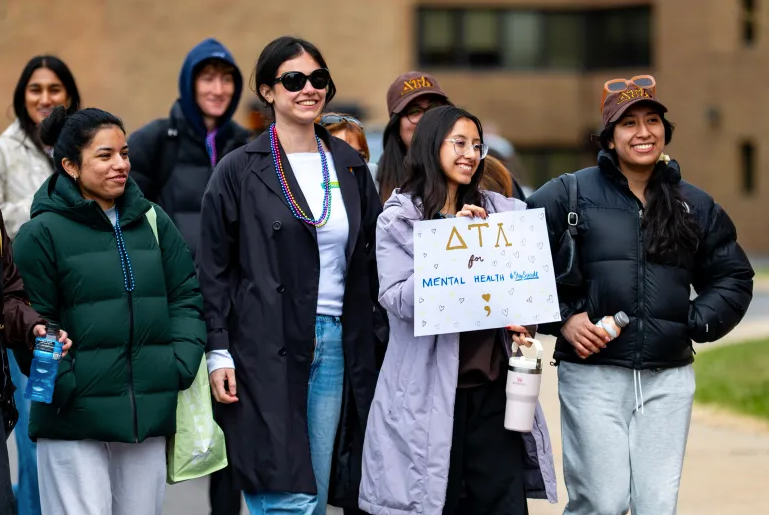
A stroll through the University of Michigan
Arlette stumbled into Delta Tau Lambda Sorority, Inc. (DTL) the way many transformative things happen: by accident and then all at once. She'd first noticed DTL through their mangonada fundraisers on campus—nothing more than a familiar snack and a curious flyer. But it was when she watched the sisters perform at a stroll showcase that something clicked. "I felt like I could be myself," she recalls. "I didn't have to change who I was."
She joined Spring 2024 at the Alpha Chapter at the University of Michigan, and from the moment she crossed, she was all in.
What drew her wasn't the prestige of joining one of the nation's most selective universities' Greek organizations. It was simpler than that: the sisters were different from one another, and they got along anyway. In a world that often asks you to shrink, the Alpha Chapter gave Arlette permission to take up space.
Rising through every role
Arlette did not rise through leadership by campaigning for it. She rose by showing up—quietly, consistently, and with her whole heart—until the roles found her.
As a junior, she stepped into the recruitment chair, spearheading a wave of events that helped grow the chapter significantly. Her efforts were recognized by UMich's Greek community, where she was awarded New Member of the Year in her first full year as a member. But rather than settling into that recognition, she moved forward. When it came time to prepare the next generation of members, she shadowed the new member education process in Spring 2025, learning every detail. Last semester, she stepped up as New Member Educator herself—guiding the chapter's first fall intake line in over 12 years.
Twelve years. Let that land for a moment. The Alpha Chapter hadn't brought in a fall line since 2013, and under Arlette's stewardship of the new member education process, they did. "Not a lot of people expected it," she says with a quiet pride that is entirely earned.
Today, she serves as Sisterhood Chair and Alumni Outreach Chair—roles she helped design. Alongside then-president, Arlette proposed the Alumni Outreach Chair position as a structural solution to a long-standing organizational challenge: keeping alumni connected. She built out a WhatsApp alumni network that not only reconnects past sisters but creates a living bridge between generations—where a collegiate sister looking for a nursing internship can find a working RN in her corner. A Midwest alumni brunch during Founders Week is already in the works.
Rights to Success: Leading with purpose, not a title
Perhaps the clearest expression of Arlette's leadership is her role in Rights to Success—a college access program that brings high school students to the University of Michigan for a day-long immersion in what higher education can look like. This year's event is on track to be the largest yet, welcoming between 60 and 80 students to campus.
The program is a collaboration between the Alpha Chapter and the Zeta Chapter of Sigma Lambda Beta International Fraternity, Inc.,, a partnership that reflects the spirit of what Arlette believes organizing should be: rooted in community, sustained by commitment. Her committee—sisters Doralicia, Vanessa, Emma, Michelle Mendoza (alumni), and Brenda Esquivel (alumni)—worked alongside Beta brothers Daniel Chavez and Richard Leon to pull it together. When grants seemed uncertain in a climate of shifting institutional funding, Arlette and Emma applied to the Optimize program and secured $2000 of which went directly to funding Rights to Success.
For Arlette, the event is personal. She was once that high school student who didn't know a school like Michigan was even a possibility. Her high school counselor—a Michigan alum—was the one who pointed her toward it. She applied almost blindly, not realizing she was applying to one of the most selective public universities in the country. She got in. She got scholarships. She moved four hours from home and became the first in her family to attend college out of state.
Now, when she watches high school students walk through Michigan's campus with that look in their eyes—the one that says wait, this could be mine—she recognizes herself in them. "You could tell in their eyes," she says, "that they're like, oh my God, this is a really cool school."

The legacy of quiet fire
That is Arlette Morales. A woman who grew up translating in waiting rooms and now advocates for patients in clinical settings. A woman who joined a sorority because she felt seen, and then spent the next two years making sure every sister after her felt the same. A woman who didn't seek a legacy—she just kept showing up until one was undeniable.
As she prepares to graduate with her Bachelor of Science in Nursing and begins applying to registered nurse positions—with dreams of critical care and, one day, travel nursing—Arlette leaves behind something more enduring than a résumé full of titles. She leaves behind a chapter that is bigger, more connected, and more alive than it was before she arrived.
She leaves behind the reminder that sometimes, the most powerful thing a leader can do is simply refuse to let passion become just another task on a checklist.
"If you're gonna do something," Arlette says, "there has to be a reason why. Why you personally feel connected to it—or how it can impact other people."
She always knew her reason. The rest of us are only just catching up.